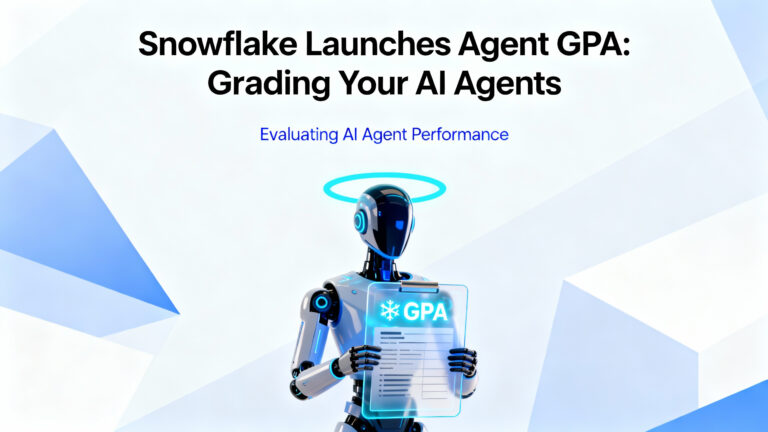
AI is moving fast, and more companies are putting smart agents to work. But how do you know if these agents are doing the job right? This week, Snowflake launched a new system called Agent GPA to help answer that question.
Agent GPA is an open-source tool that checks how well AI agents reach their goals. It gives companies a way to see not just if the answer is right, but if the steps the agent took make sense. This helps businesses trust their AI and catch problems before they grow.
Table of Contents
What Is Agent GPA?
Agent GPA stands for Goal, Plan, Action. It is a new way to score how smart agents work, beyond just checking if the final answer is correct. The idea comes from Snowflake’s AI Research team, who say that checking only the end result can hide mistakes in the steps along the way. These hidden problems can waste computer power, slow down results, and even lead to wrong business choices [source].
The Agent GPA system checks if the agent sets the right goal, makes a good plan, and follows that plan. The whole process is open source, and it works with tools like Truelens for easy testing and tracking.
Why Companies Need to Grade AI Agents
AI is showing up in more places, from helping with data work to answering customer questions. But these agents can sometimes give answers that look right, even if they took a strange or wasteful path to get there. Over time, this can cost companies money and cause trust problems. Snowflake says Agent GPA fixes this by giving a full picture of each agent’s work [source].
Other companies, like OpenAI and Anthropic, also want to make sure AI is safe and works as planned. But most tools check only the final answer, not the steps in-between. With Agent GPA, teams can spot where an agent made a mistake or took too long, giving them a chance to fix or improve the agent before it causes bigger trouble.
How Agent GPA Works
The Agent GPA system uses five main checks:
- Goal Fulfillment: Did the agent reach the goal it set?
- Logical Consistency: Did the agent’s steps make sense together?
- Execution Efficiency: Did the agent finish the task in a smart way, without wasting time or resources?
- Plan Quality: Was the plan a good match for the goal?
- Plan Adherence: Did the agent stick to its plan?
These checks are done by both humans and AI judges, which means the tool can work at scale and still match what people would say about the agent’s work. In tests, Snowflake says Agent GPA matched human judgment on up to 95% of errors, and found mistakes in popular agent tools like LangChain and Semantic Kernel [source].
Results from Real-World Testing
Snowflake ran Agent GPA on two big test sets: a public dataset called TRAIL/GAIA and its own production data. The results show that Agent GPA gives better coverage of mistakes than older systems. In one example, Agent GPA’s AI judges agreed with human reviewers 80% to 95% of the time. The tool also helped find exactly where the agent went off-track so teams could fix it [source].
This is important as companies begin using AI agents for bigger jobs, like data analysis or even project management. If an agent wastes time or makes poor choices, it can add up to lost money and lost trust.
What Makes Agent GPA Different?
Other tools look at how well an agent answers questions or completes tasks, but they do not always check the steps the agent takes. Agent GPA is one of the first open-source frameworks to look at the whole process—goal, plan, and action. This means it can spot more types of mistakes, including hidden errors that could cause trouble later.
The framework is also built for teams who want to use it in real-world systems. It comes with full documentation and can be plugged into popular AI agent platforms. Snowflake even offers a digital assistant, Cortex Code, that helps teams use AI in their day-to-day work [TechCrunch].
The Future of AI Agents in Business
Snowflake’s leaders think that by 2026, many companies will treat AI agents almost like employees. They will give agents jobs, watch their progress, and give feedback to help them learn. Some experts even imagine “manager agents” that check the work of other agents [Forbes].
With Agent GPA, companies can trust that their agents are not just fast, but also smart and careful. This could help AI fit better into teamwork, data projects, and even creative tasks.
Conclusion
The launch of Agent GPA is a big step for anyone using smart agents in the workplace. By checking not just answers, but also the thinking and actions behind them, companies get a fuller picture of how their AI is working. This can help them save time, avoid mistakes, and make smarter choices with AI.
As more companies try out agentic AI, tools like Agent GPA will be important for building trust and getting the most out of these new digital helpers. To learn more about how AI agents are changing work, check out guides from BuiltIn, ZDNet, and VentureBeat.